Security in Fragalysis
Fragalysis is a django application where data is stored in a PostgreSQL database with larger, often binary files, stored on a persistent volume that Django refers to as the Media directory.
User access to data (Targets) is controlled by serval processes that relate to authentication (knowing who a user is) and authorisation (knowing what they can access).
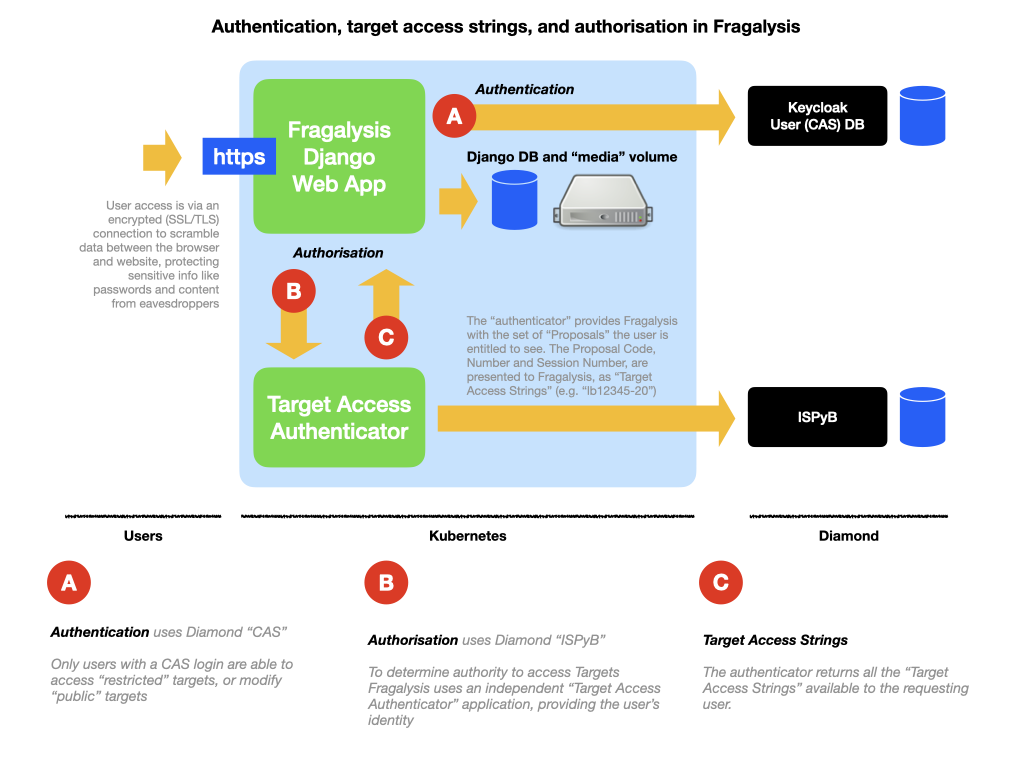
The following diagram sets the scene, and is described in more detail in the following sections.
SSL/TLS
Access to the Fragalysis stack web application passes through HTTPS, which prevents malicious network users from sniffing authentication credentials or any other information transferred between the client and server.
So, unless a user shares any data they obtain, bad actors cannot intercept the data.
Authentication (who are you?)
Django comes with a user authentication system. Although it also provides authorisation mechanisms. Because of the complexity of authorising what user can see in Fragalysis this process is deferred to a separate, independent authorisation application (discussed below).
Fragalysis uses the Django User model but authentication (knowing who a user is) is actually handled by an off-cluster Identity and Access Management service - a Diamond-managed Keycloak instance in our case. Keycloak is the source of all users, and their identities.
Users can use Fragalysis without logging in. Under these conditions Fragalysis only permits these users to access Targets that have been marked as Public. These public Targets cannot be modified by these users.
When Users login Fragalysis extends permissions to allow users to modify public Targets and also see any Target data they are authorised to see.
Making targets Public
Fragalysis stores Targets against a Project (see below), which has an
open_to_public record field. An administrator sets this field manually,
as they have access to the Fragalysis database. Targets cannot be made
public by users.
Access to Kubernetes
Fragalysis is located in a Kubernetes cluster, where its database and Media directory are also located. Users cannot access the database or media directory directly - neither presents a public surface - i.e. cannot be accessed from outside the cluster.
Fragalysis is managed by a team of administrators, who do have access to the cluster.
The team is kept small but as they have access to the cluster they are able to access the django database and the media directory - primarily for debug and maintenance duties. Consequently, as the data is not encrypted at rest, administrators ae able to see all Fragalysis data.