Continuous Deployment
AWX
Deployment relies on pre-configured Jobs on the corresponding cluster’s
AWX server. For example, on the production cluster the continuous delivery
described below relies on the following Job Templates that can be executed
by the designated GitHub Action user (github): -
Production Fragalysis Stack (Version Change)
Staging Fragalysis Stack (Version Change)
Prior to automated deployment the user is expected to have deployed the Staging and Production stacks using the following pre-configured Job Templates: -
Production Fragalysis Stack
Staging Fragalysis Stack
These job templates are typically only executed once.
Fragalysis Stack
Automated deployment of the Fragalysis Stack is achieved through the Actions
CI/CD framework and AWX. As changes are committed to the master branch
of the stack’s GitHub repositories (xchem/fragalysis-frontend,
xchem/fragalysis-backend and the xchem/fragalysis-stack itself) GitHub
launches runs the build instructions in the CI located in each project’s
corresponding workflow file.
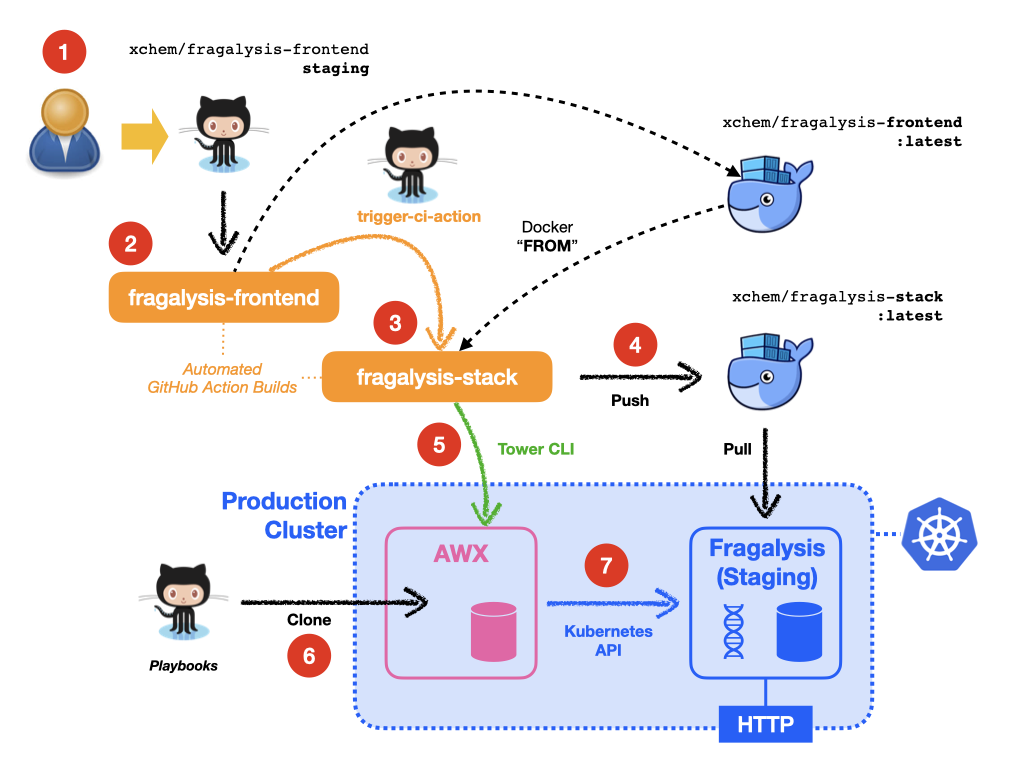
As an example, a typical sequence of actions that occur in response to a
commit to the staging branch of xchem/fragalysis-frontend repository can
be seen illustrated in the following diagram and described below: -
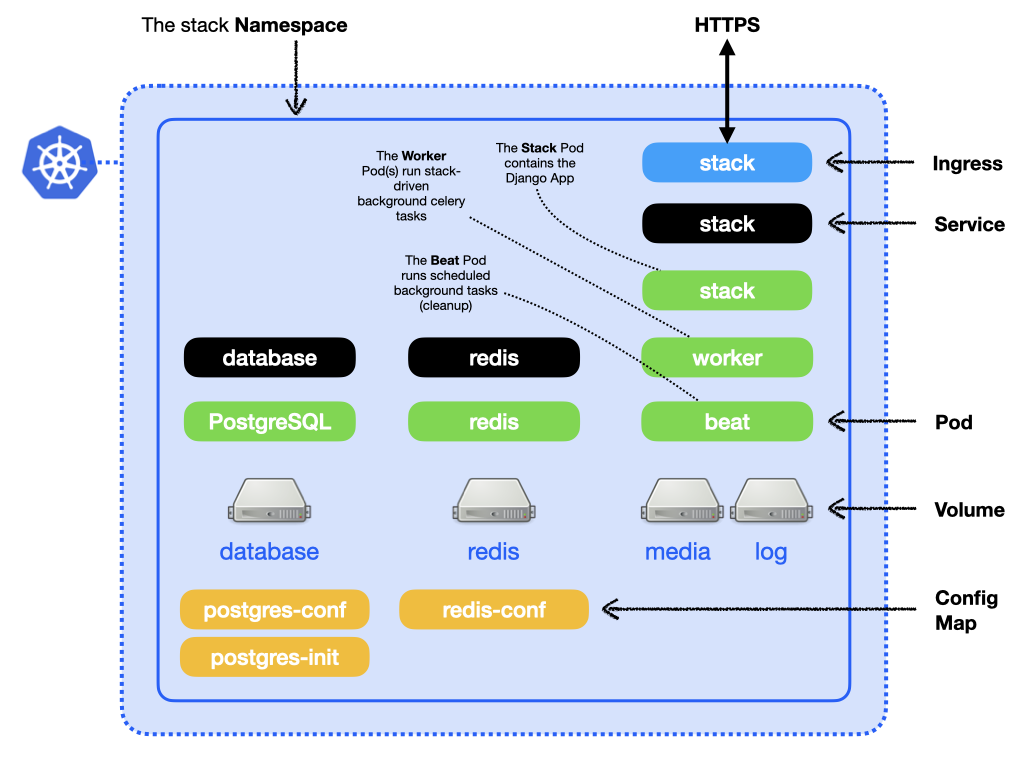
When deployed into Kubernetes the Fragalysis Stack manifests itself as a stack Pod (running the Django application) along with a database and a number of other objects, summarised in the following diagram: -
Deployment actions (from commits)
Although GitHub launches a build for every change (regardless of branch) the automated actions shown above and described here only take place when a repository’s staging branch changes (or is tagged).
A user accepts a Pull Request or makes a direct change on the
stagingbranch to thefrontendcode.A few moments later GitHub detects the change, clones the Frontend code and executes the commands in its workflow. This results in a new
fragalysis-frontend:latestcontainer image being pushed to Docker Hub.On success, the Frontend build’s instructions trigger the Stack’s GitHub build. [1]
The by-product of the Stack build is the
fragalysis-stackcontainer image. Here we see thelatesttag being used.At the end of a successful Stack build, and a new
latestimage pushed to Docker Hub, the Stack workflow has an instruction to trigger the launch of a pre-existing Job Template in the AWX server. This is achieved through the use of our trigger-awx-action. The Job’s name is injected into the build using a GitHub Repository Secret.The Action waits for the AWX Job Staging Fragalysis Stack (Version Change) AWX Job Template to complete.
The AWX Job Template executes.
Job Template execution, using the Ansible built-in k8s module, results in a forced redeployment of the Stack’s Pods (managed as a StatefulSet). The Pods restart one-by-one in an orderly fashion until all have been replaced using a fresh pull of the
latestcontainer images. This roll-out strategy should prevent any break in service.
Steps 2 to 7 above also take place when commits are made to the
fragalysis-backend repository.
Every change to the Stack’s master branch results in the execution
of the following AWX Job Template (on the PRODUCTION cluster’s AWX server): -
Staging Fragalysis Stack (Version Change)
Every production-grade Tag [2] on the Stack repo results in the execution of the following AWX Job Template (on the PRODUCTION cluster’s AWX server): -
Production Fragalysis Stack (Version Change)
Performance
The time between a commit to the Frontend repository and the start of the roll-out of the changes in the cluster is around 8 or 9 minutes. Each Stack Pod takes around 3 minutes before it’s providing a service endpoint.
In summary a typical re-deployment will take around 15 minutes.
Footnotes